

Namaste!
The yearly half-marathon by Blogchatter is back. I tend to stick to poems because they are easier to write. This time, I wanted to try something different. Though the event doesn’t require a theme, there’s no reason I shouldn’t have one.
Telugu Songs Lyrics
Telugu music has been a part of my life since I was a baby. While I enjoyed the music first and then the lyrics, in the last few years I actually focused on what makes Telugu melodies so memorable. It’s not just the tune, though we have had some marvelous music directors. It’s how the lyrics weave the tune. The lyricists played with words, meter, and rhyme scheme. Then the singers give the words a new life by adding the required emotions, stress, and intonation.
With this, I present my theme for the half-marathon: exploring a few of my favorite Telugu songs for their lyrical smarts.
And guess what? I actually planned this as a Medium series (Learning to Love my Language) three years ago before life did what it often did, and I let it go. Maybe I can revive it on the website.
(I’ll paste the same introduction for all seven posts.)
Today’s Song: Omkaram Vankara
- Movie: Sundarakanda (2008)
- Director: Bapu
- Music Director: Vidyasagar
- Lyricist: Jonnavithula Ramalingeswara Rao
- Singer: KS Chitra
This is a funny song set against the backdrop of a young woman assuring a young maid that not looking ‘perfect’ is not her fault.
The focus at the beginning is on how many things and divinities we revere are also vankara.
Vankara (vonkara) means curved, bent, crooked. Crooked has a negative connotation, but it doesn’t have to be something wrong. And that’s exactly what the song points out.
- om karam vonkara – The letter Om (ॐ) is curved
- sri karam vonkara – The letter sri (శ్రీ) is curved
- andamaina aadapilla aakaaram vonkara – a beautiful woman is curvy
- harivillu vonkara – rainbow is curved (hari is another name for Vishu, and villu is a bow)
- nelavonka vonkara – crescent moon is curved
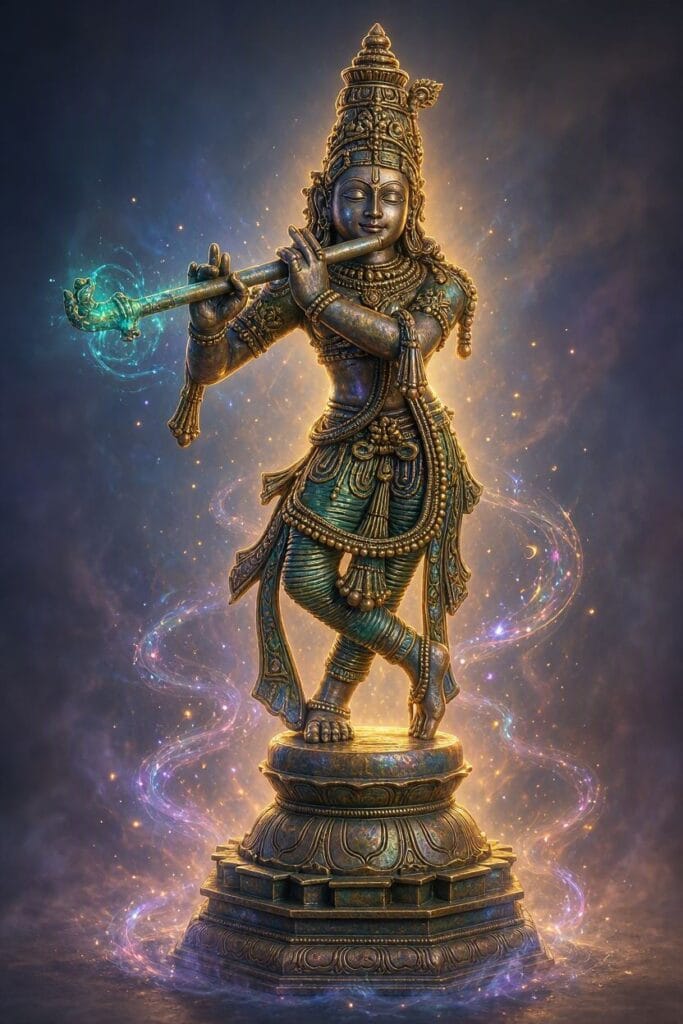
- kindanunchi paidaaka krishna moothi vonkara – from bottom to top, Krishna’s murti (idol) is curved; this is how Krishna is usually represented in murtis
- vinayakudu mukku vonkara – Vinayaka’s (Ganesha) trunk is curved
- hanumanthudi thoka vonkara – Hanuman’s tail is curved
- naradhuni maata vonkara – Narada Muni’s words are curveballs
- nandeesuni kommu vonkara – Nandi’s (Shiva’s vehicle) horns are curved
And here, it changes the tone to bring the mundane into focus
- jeedi pappu vonkara – Cashew is curved
- jilebi vonkara – Jalebi is curved
- thatha meesam vonkara – Grandpa’s mustache (associated with a position of power and prestige) is curved
- bamma alaka vonkara – Grandma’s pouting is curved (in a sense that she acts like she’s offended but is not)
You see how the repetition emphasizes the intent, while the lines fit the meter and rhythm. A couple of them also have alliteration, though that’s not a priority.
The song doesn’t actually start with the first line I mentioned here. If you watch the video, it starts with a narration where the heroine talks about change and growth, especially as a girl/woman.
Om and Sri are two sacred words for Hindus, and no matter which Indian language you use, they are written with curved letters. They also represent the divine masculine and divine feminine energies. In Telugu, Sri (శ్రీ) resembles a curvy woman, as I like to think.
Kaaram is a grammatical term (though it also means spice/chili powder). And repeating it in two lines gives you an internal rhyme.
Andamaina aadapilla aakaaram vonkara has a three-word alliteration as well. We don’t do size zero, or the latest emancipated Hollywood looks here. Healthy and beautiful people are supposed to be curvy.
Kindanunchi paidaaka krishna moothi vonkara gives a highly visual description. It clearly states that you see Krishna’s idol from bottom to top and realize that he doesn’t stand like a straight line. His feet are crossed over the ankles, one knee bent a little, the hip slightly tilted to one side; the narrow waist contrasts with his wide shoulders that appear wider as he plays his flute. His head, too, is tilted to one side, and the peacock adorning his hair is also at an angle. Everything about him is fluid, curvy, and graceful.
Then, we are told he is not the only God to have curves. Ganesha’s trunk flips to the side. Hanuman’s tail curves as it trails behind him. Nandi’s horns are perfectly curved like arches. And here, the lyricist throws a bit of cheekiness. He includes Narada Muni, known for his mastery of wordplay, and nods at it. His words are also not direct. He could say one thing and mean entirely another, but always for the greater good. Narada Muni has been a catalyst for destiny to unfold numerous times, and he takes his role very seriously.
To prevent the song from getting heavier, the lyrics switch to something more relatable: Cashews and Jalebi. Then, they switch further to connect the words to the actual plot. The grandfather, as you can see in the video, looks disgruntled and annoyed. He and his mustache represent their family name, honor, and blah blah. But that too… is curled upwards. The grandmother, who acts angry, is not really angry or annoyed. In the story, she is torn between acceptance and misunderstandings, between standing with her husband and supporting her son. Her emotions are not straight or clear. They are tangled and messy.
The lyrics go even crazier after this, so I stop here.
I liked this song the first time I heard it all those years ago, and it continues to be one of my favorites.
I learnt some Telugu today. And contemplated the beauty of curves. 🙂