

Namaste!
The yearly half-marathon by Blogchatter is back. I tend to stick to poems because they are easier to write. This time, I wanted to try something different. Though the event doesn’t require a theme, there’s no reason I shouldn’t have one.
Telugu Songs Lyrics
Telugu music has been a part of my life since I was a baby. While I enjoyed the music first and then the lyrics, in the last few years I actually focused on what makes Telugu melodies so memorable. It’s not just the tune, though we have had some marvelous music directors. It’s how the lyrics weave the tune. The lyricists played with words, meter, and rhyme scheme. Then the singers give the words a new life by adding the required emotions, stress, and intonation.
With this, I present my theme for the half-marathon: exploring a few of my favorite Telugu songs for their lyrical smarts.
And guess what? I actually planned this as a Medium series (Learning to Love my Language) three years ago, before life did what it often did, and I let it go. Maybe I can revive it on the website.
(I’ll paste the same introduction for all seven posts.)
Today’s Song: Pachandaname
- Movie: Sakhi (2000)
- Director: Mani Ratnam
- Music Director: AR Rahman
- Lyricist: Veturi Sundararama Murthy
- Singers: Clinton Cerejo and Hariharan
This is originally a Tamil movie (Alaipayuthey) dubbed into Telugu as Sakhi and later remade in Hindi as Saathiya. While every song in the movie has its own charm, this one appeals to the color crazy person in me. I loveeee colors. So, a song that uses colors to describe the hero’s lady love is an automatic favorite. Being a Mani Ratnam movie, the visuals are as mesmerizing as the lyrics. This is when I saw the white salwar kameez with a red bandini dupatta and wanted something similar.
- Pachchandanamey Pachchadanamey Tholi Tholi Valape Pachchadanamey – greenery all around, the first sprout of romantic feelings is tender green
- Pachchika Navvula Pachchadanamey Yadaku Sammatam Chelimey – (your) lovely smile is vibrant as the lush greenery (flourishing/fertile), and my heart agrees with it, dear/darling
- Pachchandanamey Pachchadanamey Edige Paruvam Pachchadanamey – greenery all around; our growing youth (beauty of youth) is green
- Nee Chirunavvu Pachchadanamey Yadaku Sammatam Chelimey
- Yadaku Sammatam Chelimey Yadaku Sammatam Chelimey
This is the kind of song Veturi garu could probably pen half-asleep. The repetition acts as rhyme and rhythm. There’s internal rhyme for the starting letter whenever it fits.
The song comes when the heroine finally reciprocates the hero’s love, so he is super-duper excited, happy, and borderline delirious. The repetition hints at this crazed happiness he displays and sees his girl in everything.
The colors go from green to red, yellow, blue, black, and drift into white.
- Thellani Telupe Yada Telipey – whitest of white tells about the heart
- Vaanalu Kadigina Tumi Telupey – the rain-washed white Tumi flowers tell (the story)
- Iru Kanu Paapala Katha Telipey – they tell the story of both sets of eyes (his and hers)
- Unna Manasu Telipey – the actual truth within the heart
- Uruku Manasu Telipey – the story of the running (fast-beating) heart
- Uruku Manasu Telipey
You can see the T’s, K’s, and U’s in these lines (the recurring Manasu, too). It’s brimming with alliteration and rhymes.
This is how Tumi flowers look. They are tiny and dainty.
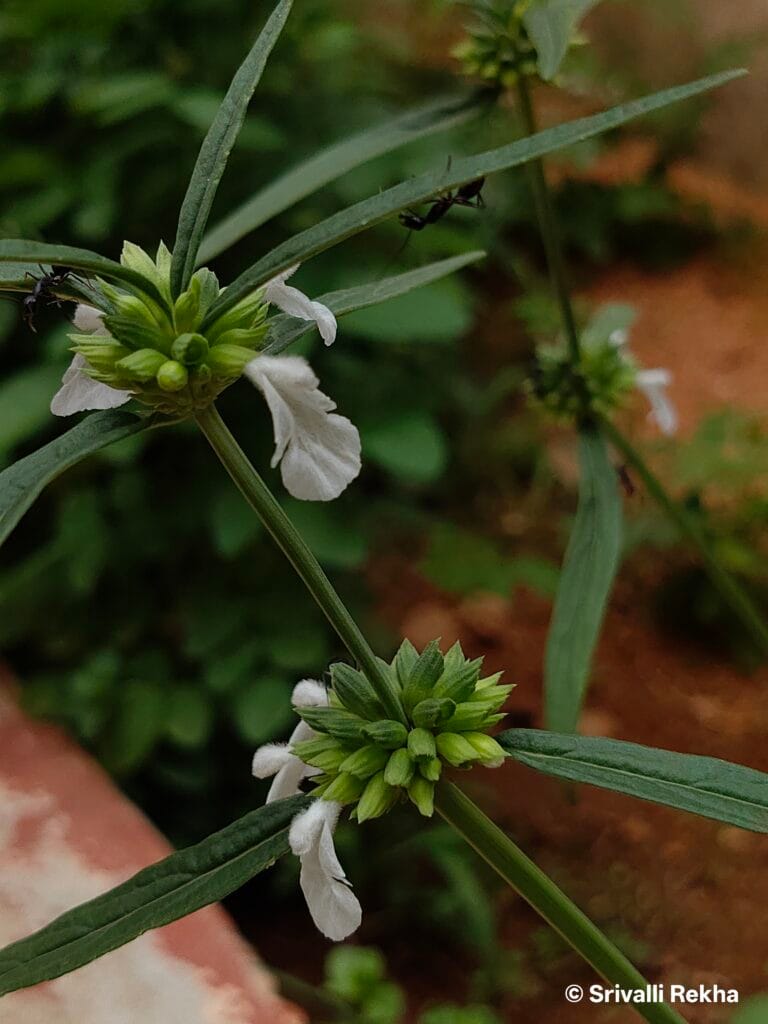
Here, the use of telupu (white) and telipey (told) plays so well with each other. In fact, telupu means both white and to tell. Hence, telipey becomes a natural rhyme for telupe(y).
Then the idea of rain-washed tiny white flowers, incidentally called Tumi, that tell the story of their eyes. It hints at the silent communication between couples, the kind where they stare at each other for no reason, but also to express their emotions, the ones they may not be able to put into words and articulate well. This is established in the subsequent lines that refer to the words in the heart and its racing heartbeat.
A heart that speeds up at the thought/sight of their lover reveals the hidden feelings through the eyes, and this story is told by those dainty little white flowers. How beautiful is that?
I used to think it was Uduku Manasu Telipey. There’s only a letter difference between uruku and uduku. Uruku means to run. Uduku means to boil (or heat). It also means jealousy. A jealous heart also fits the song (she has the right to be annoyed if he acts friendly with other women, lol), so you can see where the confusion occurred!