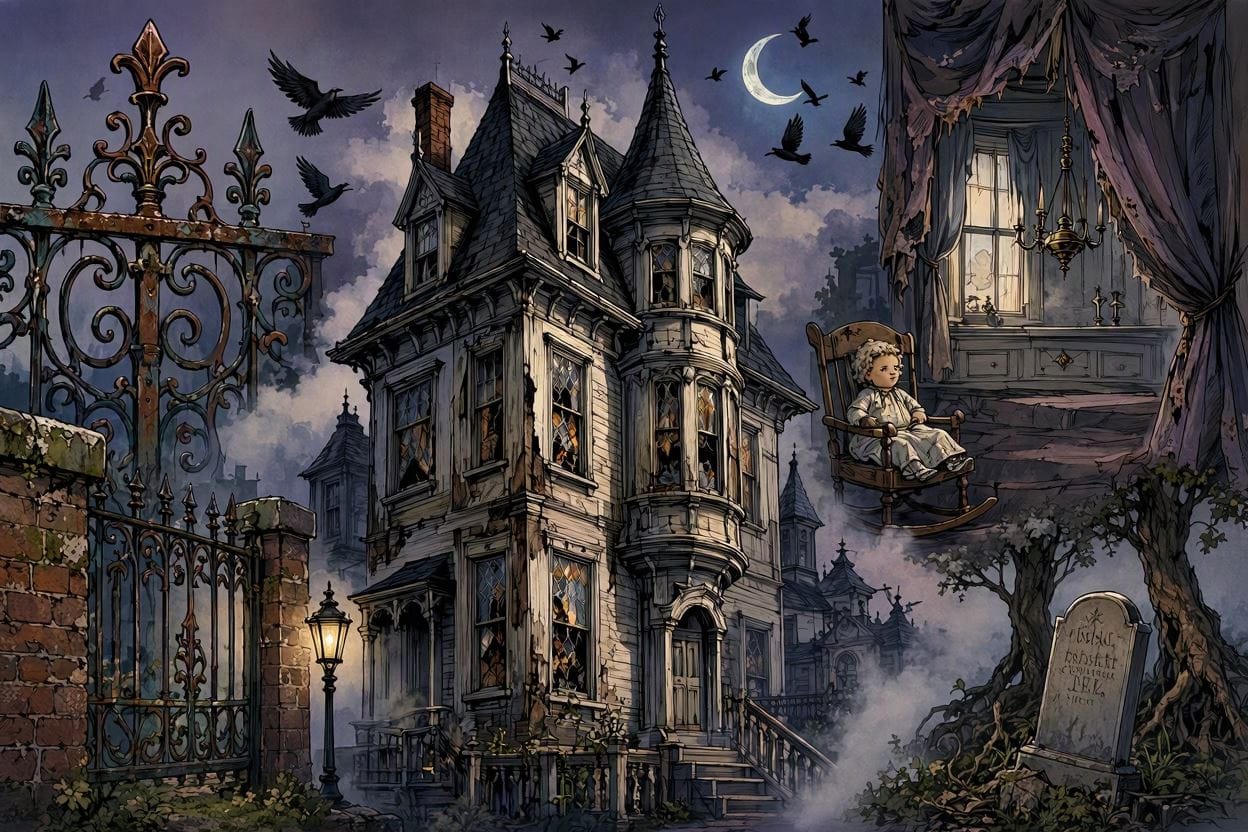

Imagine walking into an old, dilapidated house where no one dares enter, even during daytime. A musty smell tinged with something unpleasant. Cobwebs and crawly creatures are having a party. The eerie silence punctuated by random thuds and chirps. Sweat drips down your forehead even as a cold breeze hits you in the face. That’s what a haunted house does. Is it any wonder it is one of the most popular writing tropes? And not just writing. The haunted house trope is equally (if not more) famous in visual media too. Movies, TV shows, music videos, and ads use the haunted house as the setting for their horror-themed ideas.
What Is the Haunted House Trope?
One of the common storytelling tropes is the haunted house. While it predominantly belongs to the horror genre, it can also be used in other supernatural subgenres, blended with romance, thriller, mystery, crime, suspense, and humor genres. The haunted house setting is also found in gothic narratives and creates a setting with an eerie, dark, and atmospheric vibe. Being one of the well-known tropes in books and movies, it evokes a sense of familiarity and fear simultaneously.
However, the haunted house is not just a setting. It is not limited to an isolated or decayed building with supernatural elements. It is a tangible representation of something the character(s) need to achieve or conquer. For example, a character who is afraid of ghosts could spend a night in the haunted house and walk out conquering their fear. Or, they could be proven right and end up mysteriously dead. The resolution depends on what you, the writer, want to show your audience.
Key Features of the Haunted House Trope
Typically, a haunted house is defined not only by supernatural elements, but also by the history of the place. A house becomes haunted when something horrific has occurred within the walls. The incident is so dark and gruesome that it leaks and spreads throughout the house, leeching it of its light and filling the space with something violent, sinister, and nightmarish. Here, I’ll explain this writing trope through its key characteristics.
Eerie Buildings:
What’s a haunted house trope without an isolated building that has been left alone for years? However, it can also be occupied by people and still be haunted (movies like Poltergeist are an example).
A Malevolent Presence:
The house is much more than brick and mortar. It is almost sentient, filled with a supernatural presence that can take any form or no form at all. Some haunted houses have housekeepers, butlers, or a suspicious caretaker.
Tragic History:
Why did the house become haunted? What turned a regular building into the favorite spot of terrifying entities? Family murdered, abused women and children, mass deaths in a hospital, etc., are some examples.
Cultural Context:
Where is the haunted house located? The American setting differs from the European setting. For example, Indian haunted houses may echo sounds of anklets, bangles, or women laughing.
Fear of the Unknown:
The whole premise hinges on the fear of the unknown. People avoid the house because they don’t know what evil it hides. People who enter the house do it to overcome their fear or expose the story as fake, only to prove it real at the cost of their lives.
Strange Occurrences:
Flying objects, flickering lights, strange howling, laughter, music, someone singing, random disappearances, rattling doors and windows, locks that don’t work, darkness, and a breeze in a shut room are some strange occurrences that create the atmosphere and advance the plot.
Why the Haunted House Trope Works
But why do readers love this trope? What makes the haunted house so good that it is still a popular trope in fiction? There are many reasons for it. Let’s check out a few below.
Tapping into Our Deepest Fears:
The haunted house doesn’t just scare us with strange sounds and sights. It triggers our deepest fears and amplifies them. The house becomes a representation of something hidden in the darkest corners of our (characters’) hearts.
Role of History and Justice:
The haunted house doesn’t belong to the future. It is stuck in the past and repeats the loop until broken. The idea of justice lingers throughout, but can be twisted to suit the entity’s version. For example, in The House of Justice, justice is a debatable concept, yet it defines the plot.
Trapped and Lack of Autonomy:
Once you enter the haunted house, you lose autonomy to escape and get out. It’s like a locked room mystery, except that the mystery is a supernatural entity possibly intent on murder. This creates a sense of claustrophobia in the audience and makes them feel the same fear as the characters.
Invisible Enemies:
It’s easy to fight monsters and villains you can see. But in a haunted house, the characters are fighting an invisible and vastly powerful force. It highlights the power imbalance and makes the threat tangible to the audience.
A Stage for Drama:
The haunted house is a stage where all the drama happens. This can be fear, grief, rage, romance, comedy, tragedy, and a combination of two or more. It is an active participant, but also limited in its role. It’s where things happen.
The Ending:
How does the story end? Do the characters escape? Does the supernatural entity win or lose? Is the house cleansed of evil, or is it even more powerful and ready for the next victim? There is no single ending.
While I use the term ‘house’, the trope is not limited to residential buildings. An old hospital, a fort in ruins, the chapel of a deserted church, the factory shut down a few years ago, the forgotten warehouse, etc., are perfect settings.
This video gives us a lighthearted summary of the trope: https://www.facebook.com/reel/1544815830757620
Common Clichés & Pitfalls of the Haunted House Trope
As with every trope, there are certain clichés to avoid when you use the haunted house as your setting. With these storytelling tips for writers, I also highlight how the clichés can be used to enhance the plot.
Abandoned House:
What’s a haunted house trope without an abandoned building? While it is cliché, it cannot be avoided. However, you can give it your own twist in terms of size, design, era, setting, etc.
Weird and Mysterious Caretaker:
Remember a scary-looking caretaker who appears and vanishes at random? Is he evil or can he be trusted? Make him more than a red herring and give him/her/ them more depth.
Secret Passages and Booby Traps:
The haunted house has bookshelves that open into hidden rooms, secret passages, holes, and booby traps that the characters stumble upon. While these add to the atmosphere, they also need to play a cohesive role in the overall plot.
Poltergeist:
The Poltergeist movie was entertaining when I saw it as a child. A possessed building with a spirit causing physical disturbances can become cliché if it does the same things over and over again. Bring emotional depth to this.
Confusing Corridors and Rooms:
As if secret passages are not enough, the haunted house has mirroring corridors that somehow always lead the characters to danger just when they should escape it. Again, useful but can make the story feel the same as every other with the same trope.
Strange Sounds and Visions:
Indian movies and TV shows love to use the sounds of women laughing and the tinkling of their bangles and anklets, the shadow of a woman with her saree pallu fluttering behind her. You can sense her, but never see her directly! Overdoing this will flip the atmosphere from fear to apathy.
How you use the clichés can enhance the story or deflate it.
How to Write the Haunted House Trope Well
After reading the key features and clichés, the next question naturally is about how to write this trope well. The answer is not difficult. It needs creativity, planning, and strategic execution. Be ruthless when you select the elements to include in the haunted house. Sometimes, less is more.
Choose the Primary Theme:
What is the central theme of the story? Is it about the tragedy that happened in the house? The story of the poltergeist? The story of the characters who enter the house? For example, in Boothnath, Amitabh Bachchan plays a ghost who lives in the house where the little kid and his mom come to live. The story belongs to the ghost and the kid.
Sustain the Momentum:
Most horror stories start with a bang, but fizzle out in the middle. The haunted house plays in a loop with the same events happening repeatedly. Pack some twists and reveals in the middle to sustain the momentum.
Psychological Manipulation:
Mind games are a big part of the horror genre. Your tricks should convince not just the characters but the readers too. This requires clever writing and a clear idea of what you want the readers to feel.
Decide the Ending:
How does the story end? Does everyone die? Is the house cleared of the evil presence? Does the ending align with the emotional content so far? Too many twists can be counterproductive. One well-executed shocker can make you a winner.
The Degree of Horror:
Do you want to play with the spooky vibe, go the slasher route, or find a middle ground? The elements you choose have to align with the extent of horror you want and the target audience. Slasher would be too much for middle grade, but works for niche adult readers.
Balance Atmosphere with Plot:
In atmospheric and gothic horror, it is easy to pile up the incidents and strange occurrences and forget the plot. This usually happens in the middle. That’s why it is necessary to keep the plot moving while scaring the characters and readers.
Human vs. Supernatural:
Is it really supernatural stuff, or a clever mechanism by humans? Why are some people determined to make the place appear haunted? Are the good guys or the bad ones? Is a person’s quest being supported by unseen powers? Telugu movie Bhaagamathie uses this framework.
Variations of the Haunted House Trope
As I said earlier, the haunted house is not limited to the horror genre. You can use it as a subplot or a setting in other genres. The best examples would be The Addams Family and Casper. It created such a cool variation of the trope and included so many sociocultural elements that the main characters are still used in memes.
Gothic Satirical Comedy:
The Addams Family lives in a supposed haunted house beside a cemetery, has a goth vibe, but presents a social satire as cool comedy. It is serious while being funny. Scary to the side characters, but endearing to the audience.
Cute Family Drama:
In Casper, the house is haunted by the ghost of a teenage boy who lived and died there. It has funny, heartwarming, and sad moments, while combining science with the supernatural. Simultaneously, it also highlights the father-daughter bond.
Future and Sci-Fi:
Just because haunted houses are linked to past tragedies doesn’t mean you can’t set them in the future. Imagine a futuristic version, where the house is controlled by sentient AI instead of ghosts and spirits.
Portal for Time Travel:
What if the haunted house is actually a portal that leads somewhere, and people who use it don’t want anyone to know the secret? Where does it take the characters? What else does the house do? This can be dark fantasy, fantasy comedy, or horror.
Your haunted house can be anything you want it to be. Be creative!
Examples in Books and Movies
Here are a few trope examples in fiction, apart from the ones I already mentioned.
- The Haunting of Hill House by Shirley Jackson
- Home Before Dark by Riley Sager
- Just Like Home by Sarah Gailey
- The Shining by Stephen King
- The Canterville Ghost by Oscar Wilde
Check more books on this Goodreads list. A few movies are:
- The Others
- Paranormal Activity
- The Haunting
- The Innkeepers
- The House of the Devil
Check out more movies on this IMDb list.
Concluding Whispers from the Haunted House
The haunted house continues to be one of the favorite tropes, not just in horror, but also in thrillers, mysteries, and dark comedies. Play with the setting to make it come alive on the page, and preferably to haunt your audience in the best way!